Published:
How to Create an Online Cookbook for Your Own Recipes
An online cookbook sounds simple until you try to build one.
At first, you only need somewhere to put recipes. Then you realise one recipe is a website, another is a photograph, three live in a family chat, and the one you make most often is still written on a folded sheet of paper beside the flour.
A useful online cookbook is not just a document with many recipes in it. It is a living personal collection: each recipe has its own structure, you can find it later, you can correct it after cooking, and the book can keep growing without becoming harder to use.
That distinction matters. A beautiful PDF can be a finished cookbook. An online cookbook should still work on an ordinary Tuesday when you have twenty minutes to decide what to cook.
What should an online cookbook actually do?
For your own recipes, the basic test is practical rather than decorative.
You should be able to:
- add recipes from the places where you already find them;
- search the collection quickly;
- read ingredients and steps without fighting the layout;
- keep the original source;
- add your own notes and changes;
- organize without creating fifty tiny categories;
- open the same collection from the devices you normally use;
- keep a backup or export a copy.
Meal planning, shopping lists and cooking tools are useful extras because they let the cookbook participate in dinner rather than merely archive it.
Cookmory is built around that kind of collection: recipes can come in from links, photos, PDF cookbooks and text, then remain editable and usable for planning, shopping and cooking.
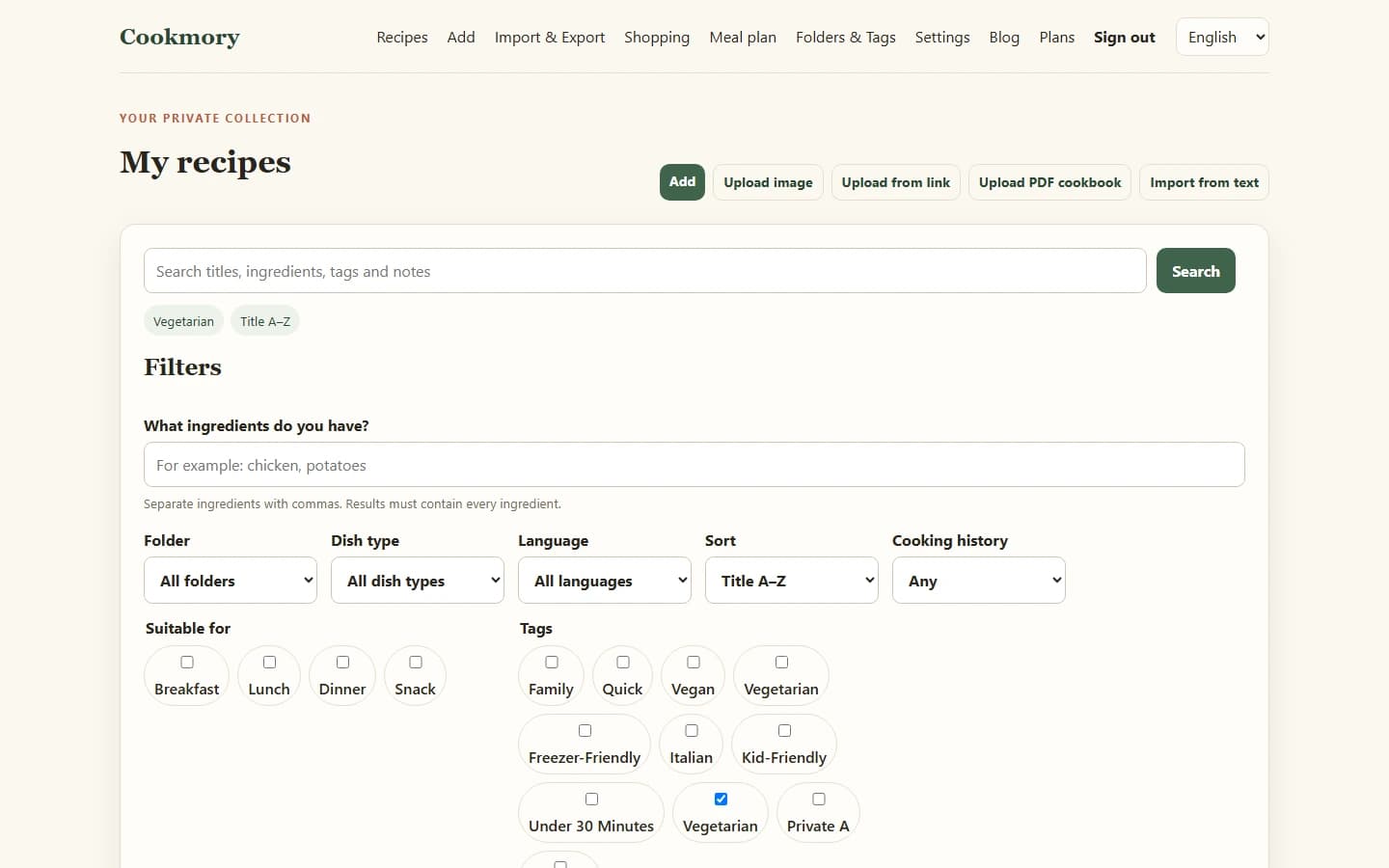
Start with the recipes you already cook
Do not begin by importing everything.
A personal cookbook becomes useful faster if the first twenty recipes are dishes you actually make. Add the soup you know by heart but always forget the amount of stock. Add the cake where your handwritten note says “35 minutes, not 45.” Add the pasta recipe you keep searching for because the original bookmark is buried in a folder.
A small working collection teaches you what structure you need. A giant migration on day one mostly teaches you how tiring migrations are.
If you already have a large archive, How to Organize Recipes Digitally explains a simple way to move it in batches without creating a second mess.
Give each recipe a consistent shape
An online cookbook is easier to search and cook from when every recipe is more than a block of text.
At minimum, keep:
- a clear title;
- ingredients and quantities;
- cooking steps;
- servings when known;
- preparation and cooking times when useful;
- the source;
- your own notes.
Add photographs when they help you recognise the dish or preserve something important about the original. Do not make a photograph responsible for carrying information that belongs in the recipe itself.
A picture of an old recipe card is valuable. It preserves the handwriting and history. A cleaned-up ingredient list beside it is what lets you cook without zooming into a faded corner of the photo.
Bring recipes in from the source you actually have
The quickest way to ruin an online cookbook project is to decide that every recipe must be typed manually.
Use the source format whenever possible:
- paste a recipe URL for a public website;
- use a supported social link when the recipe comes from a post or video;
- import a clear photograph or screenshot;
- upload a cookbook PDF;
- paste text from a message or document;
- enter a recipe manually when there is no better source.
The guide How to Import Recipes from Websites, Photos, PDFs and More compares these methods and explains when each one is the better choice.
The important part is not speed alone. Review imported recipes while the original source is still in front of you. A missing half teaspoon is easier to fix now than when the pan is already hot.
Organize lightly: broad folders, useful tags, strong search
People often over-design a cookbook before they have enough recipes to justify the design.
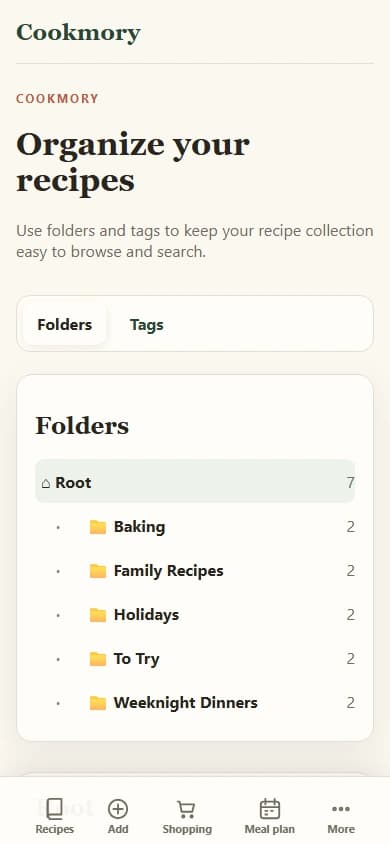
Start with a few broad folders that match the way you think about meals. For example:
- Weeknight dinners
- Baking
- Breakfast
- Family recipes
- Holidays
- Try next
Then use tags for details that overlap: vegetarian, chicken, under 30 minutes, freezer-friendly, Italian, picnic, child-approved.
The distinction is useful because a recipe can only sit comfortably in so many folders, but it can carry several tags without turning the navigation into a maze.
Search is the safety net. Give recipes names you will actually remember. “Pasta” is technically correct; “Creamy mushroom pasta with spinach” is much easier to retrieve six months later.
Keep the original source and the version that works in your kitchen
A personal cookbook becomes valuable because it accumulates your experience.
Keep the original source whenever you can, whether it is a URL, a book title, a photograph of a card or the name of the relative who sent it.
Then add your version:
- “Use 30 g less sugar.”
- “Bake on the lower rack.”
- “The sauce needs extra water after reheating.”
- “Double this for Sunday lunch.”
Those are not clutter. They are the reason your cookbook becomes more useful after a year instead of simply becoming larger.
For recipes from websites, this guide to saving online recipes explains why preserving the source is worth doing even after you have a clean structured copy.
Build the cookbook for cooking, not only for browsing
A folder of attractive recipe cards can still fail at 6:30 p.m.
Think about the moments when you actually use the collection:
Planning: What should we cook this week?
Shopping: Which ingredients do we need for the meals we chose?
Cooking: Where was I in the instructions, and how long does the second tray need?
A useful online cookbook can support those moments. In Cookmory, saved recipes can move into the weekly plan, contribute to shopping lists, and open in Cooking Mode with step-by-step navigation and timers.
That does not mean every cookbook needs every feature. It means the collection should remove work between “I saved this” and “we are eating it.”
Online cookbook, PDF or paper cookbook?
They solve different problems.
| Format | Best for | Main limitation |
|---|---|---|
| Online cookbook | A collection that changes, grows and needs search | Depends on the service/device access you use |
| PDF cookbook | A fixed edition to save, send or print | Awkward to update recipe by recipe |
| Printed cookbook | Gifts, keepsakes and comfortable page-by-page cooking | Difficult to correct and search |
You do not have to choose only one.
A sensible workflow is to keep the living collection online, maintain a portable backup, and create a PDF or printed edition when you want a snapshot of the cookbook at a particular moment.
If your goal is specifically a book for relatives, How to Make a Family Cookbook That Is Easy to Update and Share goes deeper into collecting stories, original cards and contributions from several people.
Back up the collection before it becomes irreplaceable
The more personal notes and family recipes you add, the harder the collection becomes to recreate.
Do not wait for a problem before thinking about portability. Use the backup and export options available in your chosen system, and keep important original photographs or source files where appropriate.
Cookmory provides a portable collection backup, while the current plans page shows the up-to-date export options. If you want a printable edition, a PDF is useful as an output format; it should not be the only copy of a collection you still expect to edit.
A simple weekend plan for starting your online cookbook
You do not need to dedicate a month to this.
Saturday morning: choose ten recipes you cook repeatedly.
Saturday afternoon: add them from their real sources and check the ingredients and steps.
Sunday morning: create three to five broad folders and only the tags you already know you need.
Sunday evening: use one saved recipe for dinner. Add a note after cooking.
That last step matters. The best test of an online cookbook is not whether the collection page looks tidy. It is whether you would rather cook from it than search through your old screenshots again.
FAQ
What is an online cookbook?
An online cookbook is a digital collection of recipes that you can access through the web and continue to update. A useful personal cookbook keeps recipes structured, searchable and editable rather than storing everything in one long document.
How do I create an online cookbook for my own recipes?
Start with a small set of recipes you already use, add each recipe in a consistent structure, keep the source, organize with a few broad folders and tags, and make a backup as the collection grows.
Can I add recipes from websites to an online cookbook?
Yes. A recipe importer can turn many public recipe URLs into editable recipe entries. Keep the original URL and review the imported ingredients and instructions before saving.
Can I include recipes from photos and old cookbooks?
Yes. Clear photos, screenshots and printed cookbook pages can be scanned into editable recipe drafts. For important family material, keep the original image alongside the cleaned-up recipe.
Is an online cookbook better than a PDF cookbook?
They are useful for different jobs. An online cookbook is easier to search and update; a PDF is better as a fixed edition to store, send or print. Many people benefit from keeping the live collection online and exporting a PDF when they need one.
Can I share an online cookbook with family?
That depends on the service. Cookmory includes family features on the current applicable plan, and the plans page has the up-to-date details.
Build the first useful version, not the final version
Your cookbook does not need a cover, 300 recipes or a perfect category system before it becomes useful.
Start with a handful of recipes you would be annoyed to lose. Put them in one searchable place, keep their sources, add the changes that make them work in your kitchen, and let the collection earn its structure over time.
You can start a Cookmory cookbook and build it from the recipes you already have rather than looking for another set of recipes to collect.