Published: Updated:
How to Make a Family Cookbook That Is Easy to Update and Share
A family cookbook often begins with one message:
“Does anyone have Grandma’s pie recipe?”
Then three versions arrive. One has no oven temperature. Another says “add flour until it feels right.” The third is a photograph of a card with a butter stain across the most important line.
That is normal. A family recipe is not a laboratory report. It carries habits, memories, missing details, and small disagreements.
If you are wondering how to make a family cookbook, the easiest approach is to create a digital version first. You can correct it, search it, invite relatives, and print a polished edition later without starting over.
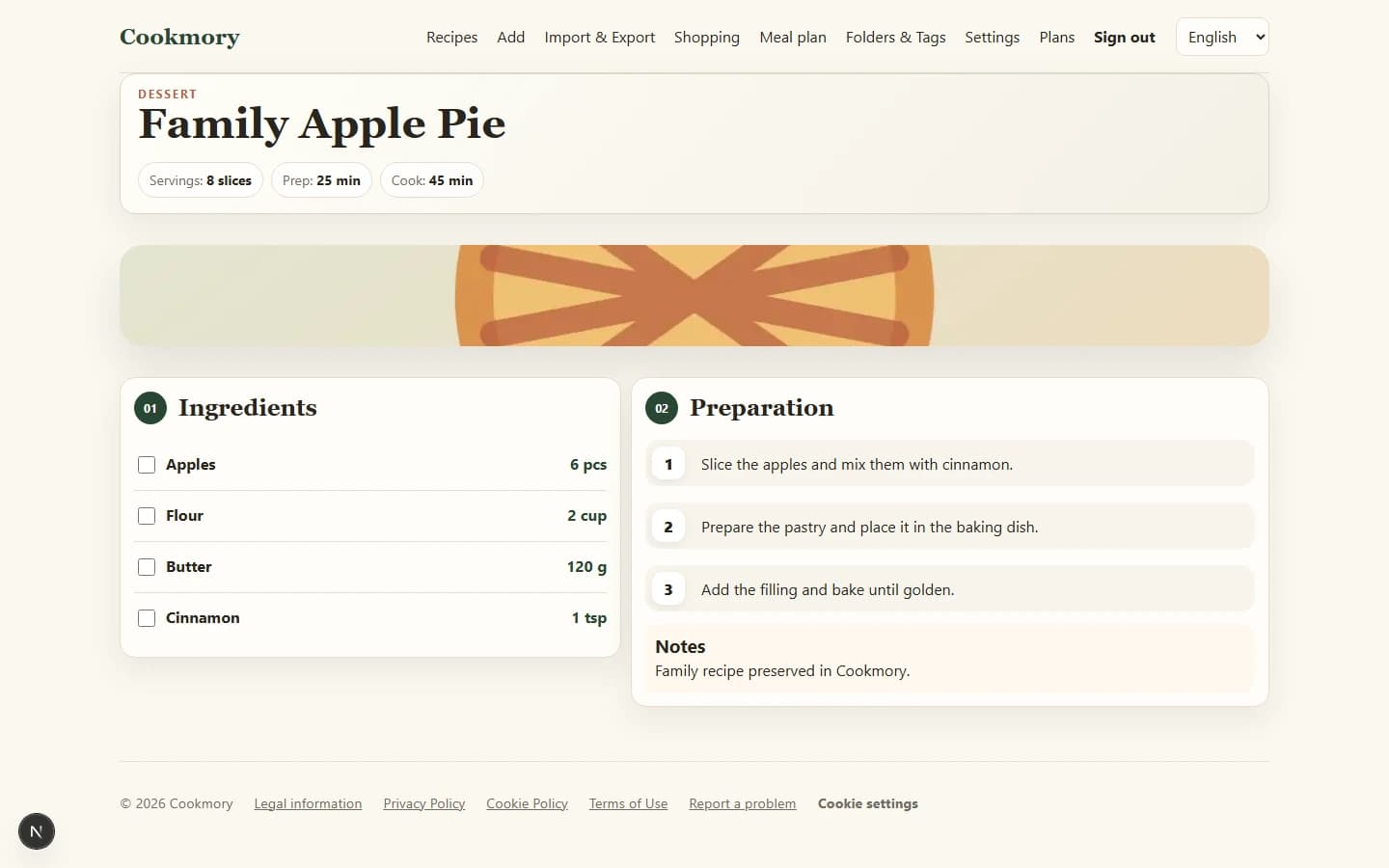
*A digital family recipe can preserve the source while making the instructions easier to read and update.*
Begin with the purpose, not the design
Before choosing fonts or a cover, decide what the cookbook should do.
Is it mainly:
- a practical collection for everyday cooking;
- a record of older family recipes;
- a gift for children and grandchildren;
- a shared book that relatives will continue to update;
- or a mixture of all four?
The answer affects what you collect. A practical cookbook needs tested quantities and clear steps. A family archive can also include incomplete recipes, original handwriting, photographs, and stories.
Write one sentence at the top of the project. For example:
We are creating a shared family cookbook that preserves the original recipes but makes the dishes possible to cook today.
That sentence will help when you have to decide whether to modernize a vague instruction or leave it untouched.
Make it digital first
A printed book is satisfying, but it is difficult to correct after fifty copies have been made.
A digital-first process lets you:
- collect contributions gradually;
- fix spelling and missing details;
- attach photographs of original cards;
- search by person, dish, or ingredient;
- create a new printed edition later;
- keep a backup if the physical book is damaged.
To create a digital cookbook, you need more than one long document. Ideally, each recipe should have its own title, ingredient list, steps, notes, source, and images. This makes the collection useful before the final book is finished.
You can still export or format it as a traditional cookbook later.
Ask relatives for recipes in one standard format
The hardest part is usually not typing. It is collecting consistent information from busy people.
Send a short request with a deadline and a simple template:
A short contribution request
I’m collecting recipes for our family cookbook. Please send one or two dishes that feel important to you. A phone photo is fine. If possible, include the recipe name, ingredients, steps, who it came from, and one short memory connected to it. Please send everything by [deadline date].
Do not ask everyone to learn a complicated system. Accept photographs, voice messages, documents, or handwritten notes. You can structure the information afterwards.
For each contribution, try to record:
- recipe title;
- contributor;
- original author, if known;
- ingredients and quantities;
- preparation steps;
- approximate servings;
- family story or occasion;
- photograph of the dish or original page;
- uncertain details that still need checking.
Preserve the story as well as the instructions
The difference between a generic cookbook and a family cookbook is context.
A short note can be enough:
- “Dad cooked this every New Year’s Eve.”
- “Aunt Lena learned it from a neighbour in Kazan.”
- “The original recipe used a drinking glass instead of a measuring cup.”
- “We always make a double batch because half disappears before dinner.”
These details make people open the book even when they are not cooking.
When learning how to make a cookbook from family recipes, it is tempting to make every page look uniform. Keep the structure consistent, but do not polish away every personal detail. A photograph of handwriting or a peculiar phrase can carry more meaning than perfect typography.
Edit gently and record uncertain details
Old recipes often assume knowledge that the original cook never wrote down.
Instead of silently guessing, use notes:
- “The original card does not specify the oven temperature; 180°C worked in our test.”
- “We believe ‘one glass’ meant approximately 200 ml.”
- “The family remembers walnuts, although they are not listed on the card.”
Test important recipes when possible. Ask another relative to cook from the edited version without verbal help. Their questions will reveal missing steps.
Keep the original photograph beside the cleaned-up version. That protects the historical record and makes future corrections possible.
Printed recipe cards can be scanned into editable text. For handwritten cards, keep the original photo and enter the recipe manually.
Organize the cookbook for real cooking
A family cookbook should be pleasant to browse, but it also has to work on a busy evening.
Use broad sections such as:
- Breakfast
- Soups and salads
- Main dishes
- Baking and desserts
- Holidays
- Preserves
- Family favourites
Then add tags or labels for people, occasions, countries, dietary needs, or cooking time.
A recipe might belong to “Baking and desserts” while carrying the tags “Grandma Nina,” “Christmas,” and “Make ahead.”
This is easier to maintain digitally than building many tiny chapters. The broader method in How to Organize Recipes Digitally can be used for the family archive as it grows.
Share now and print later
Do not wait for the cookbook to be “finished.” Family collections rarely are.
Share the first useful version and invite corrections. Someone may remember a missing ingredient only after seeing the recipe. Another relative may recognize the handwriting in an old photograph.
A shared Cookmory family space can keep recipes available while the collection develops. Family access is available on Pro. The Import & Export tools can then support the digital-first, printable-later workflow without making a PDF the only surviving copy.
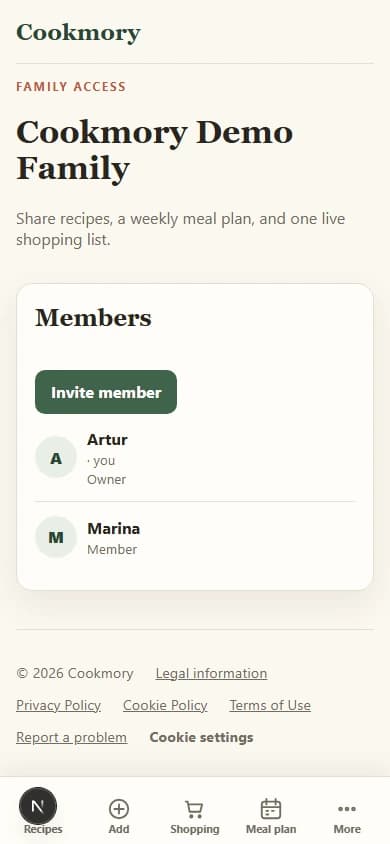
*A shared family space lets contributors keep improving the collection instead of treating the first edition as final.*
When you do print the book, add:
- a date and edition number;
- a list of contributors;
- a note explaining how corrections can be submitted;
- the location of the current digital edition.
A one-week family cookbook plan
Day 1: Write the purpose and choose ten essential recipes. Day 2: Create a standard recipe template. Day 3: Contact relatives and request contributions. Day 4: Add the first scanned cards and photographs. Day 5: Clean up ingredients and steps without deleting original wording. Day 6: Ask one person to test a recipe from the written instructions. Day 7: Share the first small edition.
Ten complete recipes are more useful than a beautiful empty template. Start small enough to finish.
FAQ
What is the easiest way to make a family cookbook?
Create a digital collection first, use one recipe template, ask relatives for a small number of contributions, and publish an initial edition before trying to collect everything.
How many recipes should a family cookbook contain?
There is no required number. A focused book with 20 meaningful, tested recipes can be more valuable than a large collection of incomplete entries.
Should I change old family recipes?
Clarify missing steps and quantities, but keep the original version or photograph. Mark any tested changes so future readers can distinguish the source from later edits.
Can a digital family cookbook be printed?
Yes. A structured digital archive is often the safest starting point because it can be corrected and expanded before being exported or formatted for printing.
How do I collect recipes from relatives?
Ask for one or two recipes at a time, accept phone photographs and voice messages, provide a short template, and give a clear deadline.
Start with the first family recipe
Create a Cookmory collection, add the original photo, type the readable version, and invite your family to help preserve the next one.