Published:
How to Double a Recipe: Ingredients, Servings, Cooking Time and Common Mistakes
Doubling a recipe looks simple: multiply every quantity by two and cook twice as much food. The arithmetic is simple. The cooking is not always.
Eight chicken thighs need roughly twice the chicken of four. But a crowded pan browns differently, a doubled cake batter may not belong in the same pan, and a larger pot of soup does not automatically need twice the simmering time.
The useful way to double a recipe is to separate two questions: How much of each ingredient do I need? And: does the cooking method still work at the larger size?
The basic rule: multiply quantities by the serving factor
If a recipe serves four and you need eight, the factor is 2. Each measurable ingredient starts by being multiplied by two.
| Ingredient | Original | Doubled |
|---|---|---|
| Chicken thighs | 4 | 8 |
| Rice | 300 g | 600 g |
| Stock | 600 ml | 1.2 L |
| Onion | 1 | 2 |
| Olive oil | 2 tbsp | 4 tbsp |
For a four-serving recipe that needs to serve six, use 6 ÷ 4 = 1.5. That is what a recipe converter does: it changes quantities while keeping their proportions consistent.
Ingredients that need a little judgement
Flour, rice, stock, chopped vegetables, meat, and many liquids usually scale cleanly. Salt, chilli, soy sauce, strong spices, and intense herbs deserve a taste near the end. A doubled amount is a sensible starting calculation, not a reason to stop tasting.
Eggs are easy when the result is whole. For awkward fractions, beat an egg separately and measure half by weight or volume when precision matters. Baking powder, soda, and yeast also deserve care on very large batches: pan depth, dough temperature, and fermentation still affect the result.
Cooking time usually does not double
If a casserole takes 40 minutes, doubling ingredients does not mean 80 minutes. Cooking time depends on depth, pan material, crowding, starting temperature, and how heat can circulate.
Use the original time as a checkpoint. Begin checking there, then judge doneness by temperature, texture, browning, tenderness, or the usual test for the dish.
Pan size matters more than people expect
Double brownie batter in the original pan and it becomes much deeper. The ratios are correct, but the baking conditions have changed. The same issue affects sheet-pan meals, gratins, roasted vegetables, breads, and casseroles.
When possible, keep roughly the same food depth with a larger pan or two pans. Two normal batches are often more reliable than one oversized one. A tray that says “single layer” is telling you the same thing: two layers of vegetables steam instead of brown.
A practical way to double a recipe
1. Confirm the original serving size
Do not assume that a recipe makes “one dinner.” Find the stated servings or yield.
2. Scale structured quantities
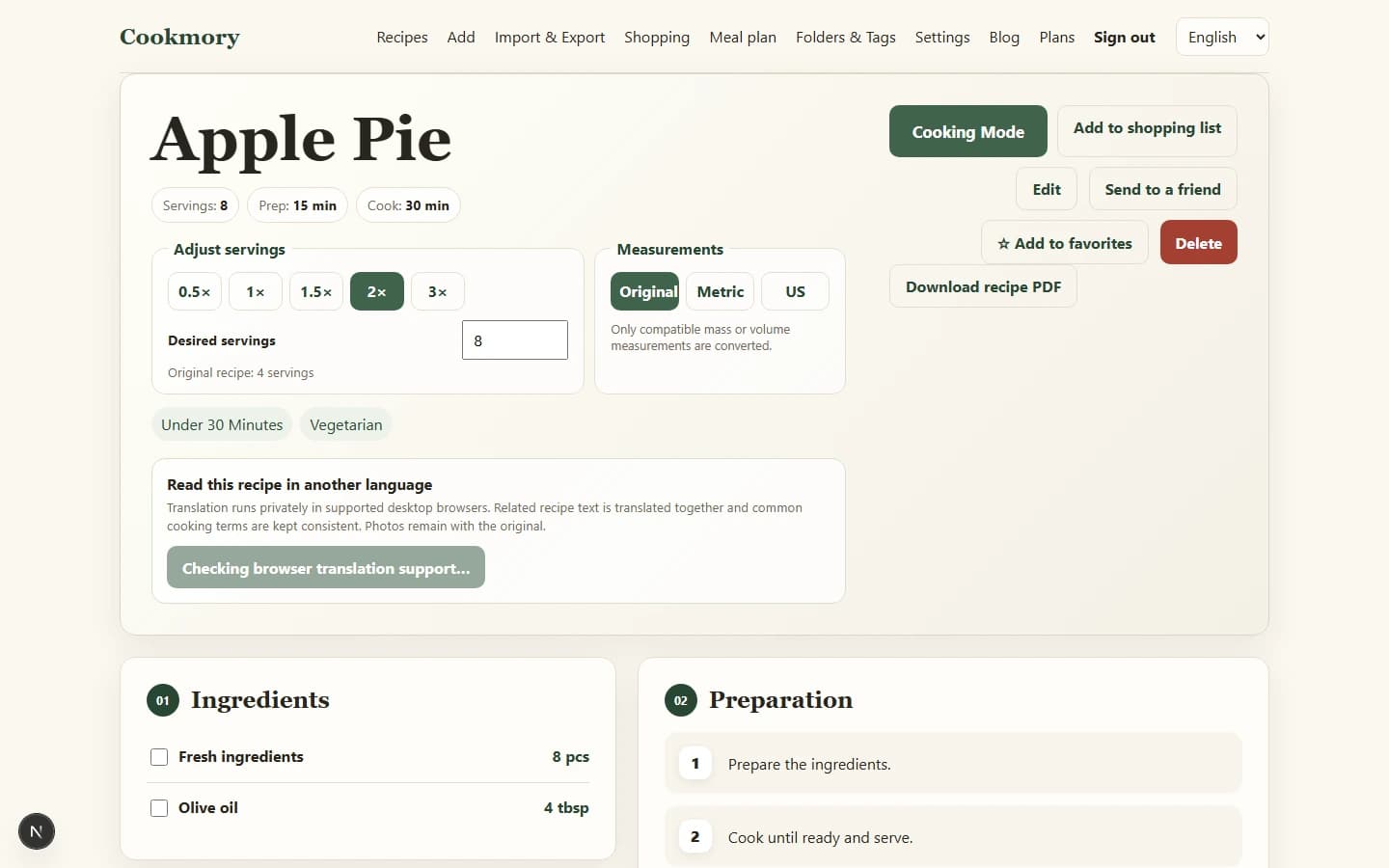
Fractions are where copying a recipe into free text becomes error-prone: 1/4 cup becomes 1/2 cup; 3/4 teaspoon becomes 1 1/2 teaspoons. In Cookmory, a recipe's original servings and structured ingredient quantities stay together.
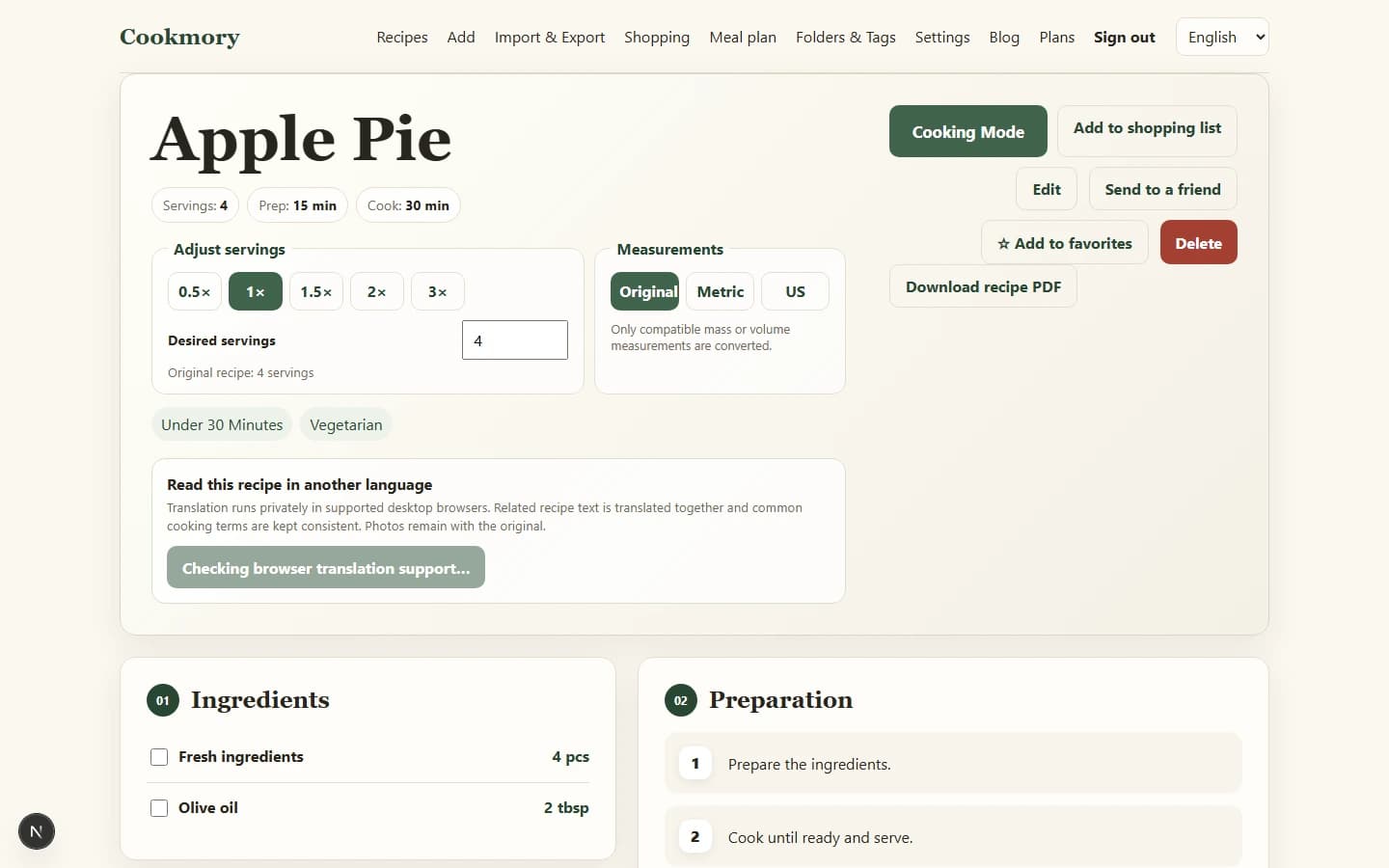
The recipe view can change the serving count and recalculate interpretable ingredient quantities. Review any non-numeric quantity or seasoning before cooking.
3. Check whether your equipment still fits
Ask whether the pot is large enough, whether food will still fit in one layer, whether batter depth stays similar, and whether you need two trays. Solve this before half the ingredients are in the bowl.
4. Keep the method, not just the timer
Preserve browning, airflow, simmering, kneading, chilling, and resting conditions as closely as possible. Start checking at the original time, not a mathematically doubled timer.
5. Finish seasoning by taste
For savoury dishes, hold back a little salt, acid, chilli, or herbs if you are unsure. It is easy to add more and hard to remove it.
When two batches are better
Make two normal batches if a pan or mixer is at capacity, browning depends on a single layer, the recipe is sensitive to pan depth, or failure would waste expensive ingredients. There is no prize for fitting everything into one bowl.
What about halving a recipe?
Multiply by 0.5, but look out for indivisible items, tiny quantities, and smaller, faster-cooking pans. Half an onion is easy. Half of 1/8 teaspoon is not. Smaller baking batches can finish sooner, so check earlier.
FAQ
Do I double every ingredient when I double a recipe?
Start by doubling measurable ingredients, then use judgement for strong seasoning and recipes where pan size, fermentation, or baking chemistry matters.
Do I double the cooking time for a doubled recipe?
Usually not. Start checking around the original cooking time and continue until the food is properly cooked.
Can I double a baking recipe?
Often, but baking is less forgiving. Preserve ratios carefully, use suitable pans, and consider two normal batches for sensitive recipes.
How do I change a recipe from four servings to six?
Use a scaling factor of 1.5. Multiply scalable quantities by 1.5, then check the equipment and cooking method.
Scale the recipe, then cook it like a cook
The numbers are only the first half. Multiply the quantities, then look at the pan depth, the skillet crowding, the batch size, and the seasoning. A structured recipe helps you keep one dependable original instead of maintaining near-duplicate versions. For a system that makes those recipes easy to find later, read how to organize recipes digitally.
Save a recipe and adjust it for your table
Keep ingredients, servings, and cooking notes together in one editable recipe.